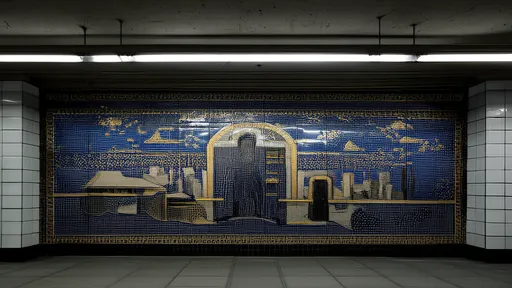
In the relentless rhythm of urban transit, where commuters are often absorbed in the immediacy of their journeys, an unexpected form of storytelling quietly persists. Across the globe, ceramic murals embedded within subway stations are doing more than merely adorning cold, utilitarian spaces; they are serving as fragmented, yet profound, narrators of city memory. These artworks, often overlooked in the daily rush, compile a mosaic of historical, cultural, and social fragments, offering a unique lens through which to view the soul of a metropolis.
The concept of the subway as a mere conduit for movement is being challenged by these intricate ceramic installations. Unlike grand monuments in city squares or curated museum exhibits, these murals operate on a different frequency. They are encountered incidentally, in stolen glances between train arrivals, their narratives absorbed subconsciously by the rushing crowds. This creates a distinctly modern and democratic form of public art, one that is integrated into the fabric of everyday life rather than set apart from it. The ceramic medium itself is crucial; its durability ensures these stories can withstand the test of time and the constant flow of humanity, while its tactile, handcrafted quality offers a tangible, human counterpoint to the steel, concrete, and digital screens that dominate the underground environment.
These murals function as a form of fragmented narrative, a concept central to understanding modern urban experience. A city’s memory is not a single, linear story but a collage of countless individual and collective experiences, myths, and historical events. A ceramic mural series does not attempt to tell a complete, chronological history. Instead, it presents shards—a pivotal moment, a forgotten industry, a mythological figure, a neighborhood’s vanished streets. In Moscow’s metro, for instance, majestic mosaics celebrate Soviet cosmonauts and industrial triumphs, fragments of a grand, state-sponsored narrative. Conversely, in Lisbon’s Olaias station, abstract ceramic designs evoke a more poetic, emotional fragment of the city's aesthetic spirit post-Expo '98. Each mural is a piece of a larger, incomplete puzzle, inviting passengers to subconsciously connect these dots and construct their own understanding of the city’s past and identity.
The very location of these artworks deep underground lends them a powerful, almost archaeological significance. To descend into a subway is to move through layers of a city’s foundation, both literally and metaphorically. Placing narratives here suggests they are foundational to the city’s identity—stories buried but not forgotten, waiting to be rediscovered. In New York City, the iconic Times Square subway mosaic, with its depiction of Robert F. Kennedy’s "star-dust" quote, serves as a permanent, subterranean memorial to a moment of national trauma and hope. It is a memory fragment preserved in the city’s underpinnings, encountered by millions who may know the full story or may be prompted to discover it. This transforms the subway from a simple passageway into a dynamic archive, where the act of travel becomes subtly intertwined with an engagement of collective memory.
Furthermore, the creation of these murals is often a collaborative process that itself becomes part of the city’s narrative. They are frequently the product of artists working with local historians, community groups, and even school children. This process unearths and validates marginalized or fading stories, ensuring they are cemented—quite literally—into the public realm. A mural depicting the history of a displaced immigrant community or a shuttered factory becomes an act of resistance against historical amnesia. It gives a voice to those fragments of the past that might otherwise be erased by rapid urban development and gentrification. Therefore, the murals are not passive relics; they are active agents in the ongoing negotiation of a city’s memory, challenging dominant narratives and celebrating the diversity of experiences that constitute urban life.
However, the fragmented nature of this storytelling also presents a unique challenge. Without context, these artistic snippets risk becoming mere decoration, their deeper meanings lost to the hurried passenger. The narrative remains incomplete, open to misinterpretation or simply ignored. This is the inherent tension and beauty of the form: it does not force a story upon the viewer but instead offers it as a gift for those willing to pause and look closer. Some transit authorities have begun to integrate QR codes or small plaques to provide context, but the primary power of the mural lies in its visual and emotional immediacy—its ability to evoke a feeling or a question in a split second.
In conclusion, the ceramic murals of the world’s subway systems are far more than aesthetic enhancements. They are a vital, though often subtle, mechanism for cultural preservation and identity formation in the modern urban landscape. Through their fragmented, durable, and public nature, they collect the shards of city memory—the triumphs, tragedies, myths, and mundane realities—and display them in the most democratic of galleries. They remind us that a city’s history is not confined to textbooks but is lived and remembered in its very foundations, offering poignant, beautiful fragments of narrative to anyone who cares to look up from their phone on their journey from point A to point B.

By /Aug 28, 2025

By /Aug 28, 2025
By /Aug 28, 2025

By /Aug 28, 2025

By /Aug 28, 2025

By /Aug 28, 2025

By /Aug 28, 2025
By /Aug 28, 2025
By /Aug 28, 2025

By /Aug 28, 2025

By /Aug 28, 2025
By /Aug 28, 2025
By /Aug 28, 2025

By /Aug 28, 2025
By /Aug 28, 2025
By /Aug 28, 2025

By /Aug 28, 2025

By /Aug 28, 2025
By /Aug 28, 2025
By /Aug 28, 2025
