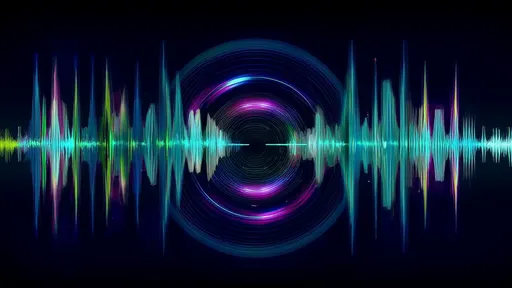
In the ever-evolving intersection of art and technology, a fascinating experiment has been capturing the attention of both audiophiles and visual artists alike. Titled "Music Visualization: An Experiment in Color Conversion of Sound Waves," this project delves into the transformative process of turning auditory vibrations into a stunning visual spectrum. The core premise revolves around the idea that sound, often experienced as an invisible force, can be given a tangible, colorful form, allowing for a multisensory engagement with music that transcends traditional listening experiences.
The experiment employs advanced algorithms to analyze the frequency, amplitude, and timbre of sound waves in real-time. Each sonic element is meticulously mapped to a specific hue, saturation, and brightness within the color spectrum. For instance, low-frequency bass notes might manifest as deep, resonant blues or purples, while high-pitched melodies could translate into vibrant yellows or sharp whites. This intricate mapping is not arbitrary; it is grounded in principles of psychoacoustics and color theory, ensuring that the visual output feels intuitively connected to the auditory input. The result is a dynamic, flowing canvas where music doesn't just play—it paints.
One of the most compelling aspects of this research is its exploration of emotional resonance through color. The team behind the experiment has conducted numerous trials to assess how viewers emotionally respond to these visualizations. Preliminary findings suggest that certain color patterns evoked by specific musical pieces can amplify the emotional impact of the music itself. A melancholic piano sonata, when visualized, might wash the screen in somber grays and deep indigos, enhancing the listener's sense of introspection. Conversely, an upbeat electronic track could explode into a riot of neon greens and fiery oranges, elevating feelings of excitement and energy. This synergy between sound and sight opens new avenues for artistic expression and therapeutic applications.
The technological backbone of this project is as innovative as its artistic aspirations. Utilizing high-speed processors and custom-developed software, the system can handle complex musical compositions without any perceptible lag. The algorithms are designed to be adaptive, learning from each performance to refine the color mappings. This machine learning component ensures that the visualizations become more nuanced and responsive over time, offering a unique experience with each iteration. Moreover, the experiment supports various musical genres, from classical symphonies to modern synth-wave, demonstrating its versatility and broad applicability.
Beyond its artistic merits, the experiment has significant implications for accessibility in the arts. For individuals with hearing impairments, visualizing music provides an alternative medium to experience and appreciate musical artistry. The colors and movements can convey the rhythm, intensity, and emotional tone of a piece, making music more inclusive. Similarly, those with visual impairments might benefit from descriptions of these visualizations, adding a layer of richness to their auditory experience. This dual approach highlights the potential of such technologies to bridge sensory gaps and foster a more inclusive cultural landscape.
The researchers are also investigating the therapeutic potential of music visualization. In clinical settings, therapists could use these visualizations to help patients articulate emotions that are difficult to express verbally. For example, a patient listening to a curated playlist might see their emotional state reflected in the colors, providing a starting point for discussion and healing. Early pilot studies in music therapy have shown promising results, with participants reporting a deeper connection to the music and a greater awareness of their emotional responses. This application underscores the experiment's relevance beyond entertainment, positioning it as a tool for mental and emotional well-being.
Looking ahead, the team plans to integrate interactive elements, allowing users to manipulate the visualizations in real-time through gestures or additional audio inputs. This interactivity could transform passive listeners into active participants, co-creating the visual narrative of the music. Imagine a live concert where the audience's movements influence the colors on screen, or a home system where your humming adjusts the visual output. Such developments would further blur the lines between creator and consumer, offering a more immersive and personalized experience.
In conclusion, "Music Visualization: An Experiment in Color Conversion of Sound Waves" is more than a technical marvel; it is a profound exploration of how we perceive and interact with art. By giving color to sound, it enriches our sensory palette and challenges conventional boundaries between mediums. As this technology continues to evolve, it promises to redefine not only how we experience music but also how we connect with each other through shared, multisensory journeys. The experiment stands as a testament to human creativity and the endless possibilities that emerge when science and art converge.
By /Aug 28, 2025
By /Aug 28, 2025
By /Aug 28, 2025

By /Aug 28, 2025
By /Aug 28, 2025

By /Aug 28, 2025

By /Aug 28, 2025

By /Aug 28, 2025

By /Aug 28, 2025

By /Aug 28, 2025
By /Aug 28, 2025

By /Aug 28, 2025

By /Aug 28, 2025

By /Aug 28, 2025

By /Aug 28, 2025

By /Aug 28, 2025
By /Aug 28, 2025

By /Aug 28, 2025
By /Aug 28, 2025

By /Aug 28, 2025
