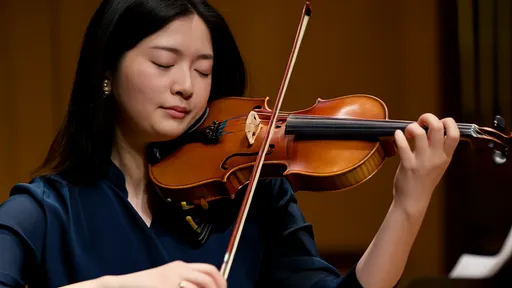
The art of violin vibrato is one of the most nuanced techniques in a musician’s arsenal, capable of transforming a simple note into a vessel of profound emotional expression. Unlike technical exercises that focus on speed or precision, vibrato demands a deeper connection between the player and their instrument. It is not merely a mechanical motion but a language of its own, speaking through subtle variations in pitch and intensity. For centuries, violinists have used vibrato to convey emotions ranging from tender longing to fiery passion, making it an indispensable tool for musical storytelling.
At its core, vibrato is the controlled oscillation of pitch around a central note. While the physics of the technique can be explained in terms of finger movement and string tension, its true magic lies in its emotional resonance. A well-executed vibrato can make a single note weep or sing, depending on the performer’s intent. The width, speed, and consistency of the vibrato all contribute to its emotional impact. A narrow, fast vibrato might evoke tension or excitement, while a slower, wider vibrato often suggests warmth or melancholy. The challenge for violinists is to master these variations and deploy them instinctively in performance.
Training for emotional expression through vibrato begins with developing a keen awareness of one’s own playing. Many students initially focus on the physical mechanics—rolling the finger back and forth on the string—but this alone does not produce expressive vibrato. The player must learn to listen critically, adjusting their technique in response to the sound they produce. This requires patience and a willingness to experiment. Often, the most compelling vibrato emerges when the player stops thinking about the motion and instead focuses on the emotion they wish to convey. The body, in time, learns to follow the heart.
The relationship between vibrato and emotion is deeply personal. What sounds sorrowful to one listener might strike another as nostalgic or even serene. This subjectivity is what makes vibrato such a powerful expressive tool. A violinist must develop not only technical control but also an intuitive understanding of how their vibrato will be perceived. This involves studying the interpretations of master violinists, analyzing how they use vibrato to shape phrases and highlight emotional peaks in the music. It also requires self-reflection, as the player discovers which vibrato styles feel most authentic to their own artistic voice.
One of the most effective ways to cultivate emotional vibrato is through improvisation. By playing without sheet music or predetermined structure, violinists can explore the immediate connection between their emotions and their technique. Improvisation encourages risk-taking and spontaneity, qualities that are essential for expressive playing. Another valuable exercise is to play familiar pieces with exaggerated vibrato, then with minimal vibrato, noting how each approach changes the emotional character of the music. Over time, these exercises help the player develop a versatile vibrato that can adapt to any musical context.
The emotional power of vibrato is not limited to solo performance. In ensemble settings, vibrato can be used to blend with other instruments or to stand out as a solo voice. Chamber musicians, for example, often adjust their vibrato to match their colleagues, creating a unified sound. In orchestral playing, vibrato can be employed selectively to emphasize key moments in the score. The ability to modulate one’s vibrato in response to the musical environment is a mark of a mature and emotionally intelligent player.
Ultimately, vibrato is more than a technical skill—it is a bridge between the violinist’s inner world and the listener’s experience. The most memorable performances are those in which the vibrato feels like an extension of the player’s soul, a direct transmission of feeling from one human to another. This level of artistry cannot be rushed; it develops over years of dedicated practice and emotional exploration. For those willing to embark on this journey, the rewards are immeasurable. A well-honed vibrato does not just enhance the music—it breathes life into it.
By /Aug 7, 2025

By /Aug 7, 2025

By /Aug 7, 2025
By /Aug 7, 2025
By /Aug 13, 2025
By /Aug 7, 2025

By /Aug 7, 2025
By /Aug 7, 2025
By /Aug 7, 2025
By /Aug 7, 2025
By /Aug 7, 2025
By /Aug 7, 2025
By /Aug 13, 2025
By /Aug 13, 2025
By /Aug 7, 2025

By /Aug 7, 2025

By /Aug 7, 2025

By /Aug 7, 2025
By /Aug 13, 2025
By /Aug 13, 2025
