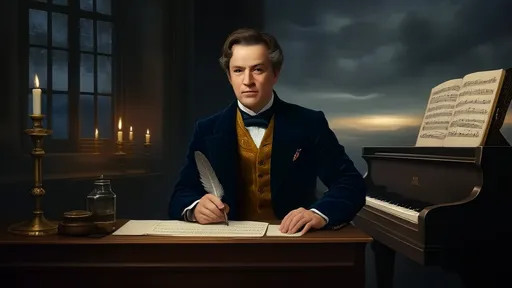
Giuseppe Verdi stands as a colossus in the world of opera, his name synonymous with dramatic intensity, unforgettable melodies, and profound human emotion. Often hailed as the "Shakespeare of Opera," Verdi’s works transcend mere entertainment, delving into the complexities of love, power, betrayal, and redemption. His ability to weave intricate narratives with music that speaks directly to the soul has cemented his legacy as one of the greatest composers in history. Like Shakespeare, Verdi possessed an uncanny understanding of the human condition, crafting characters that resonate across time and culture.
The comparison to Shakespeare is not merely superficial. Both artists shared a gift for storytelling that balanced grandeur with intimacy, and both explored themes that remain universally relevant. Verdi’s operas, much like Shakespeare’s plays, are populated by flawed heroes, vengeful villains, and tragic lovers—all brought to life through music that amplifies their emotions to breathtaking heights. From the political intrigue of "Don Carlo" to the heart-wrenching despair of "La Traviata", Verdi’s works are a masterclass in dramatic expression.
Born in 1813 in the small village of Le Roncole, Italy, Verdi’s early life was marked by hardship and loss. Yet, these struggles only fueled his artistic fire. His breakthrough came with "Nabucco" in 1842, an opera whose chorus of Hebrew slaves, "Va, pensiero", became an anthem of Italian nationalism during the Risorgimento. This intersection of art and politics would become a recurring theme in Verdi’s career, as his works often mirrored the tumultuous era in which he lived. His music was not just entertainment; it was a reflection of the hopes and struggles of a nation.
Verdi’s middle period saw the creation of some of his most enduring works, including "Rigoletto", "Il Trovatore", and "La Traviata". These operas are celebrated for their melodic richness and emotional depth, but they also pushed boundaries in terms of subject matter. "La Traviata", for instance, shocked audiences with its sympathetic portrayal of a courtesan, a character type previously relegated to the margins of moralistic tales. Verdi’s willingness to confront societal taboos head-on further solidified his reputation as a revolutionary artist.
As Verdi matured, his compositions grew even more sophisticated. "Aida", commissioned to celebrate the opening of the Suez Canal, is a spectacle of grandeur, yet it never loses sight of the personal tragedies at its core. The opera’s titular character, a slave torn between love and duty, is one of Verdi’s most poignant creations. Similarly, "Otello" and "Falstaff", his final operas, showcase a composer at the peak of his powers, unafraid to experiment with form and texture while remaining deeply rooted in the traditions of Italian opera.
What truly sets Verdi apart, however, is his ability to make the universal feel personal. His operas are not just stories set to music; they are emotional journeys that invite audiences to see themselves in the characters. The despair of Rigoletto, the passion of Violetta, the ambition of Macbeth—these are not distant figures but mirrors of our own fears and desires. Verdi’s genius lies in his capacity to translate these raw emotions into music that is at once immediate and timeless.
Verdi’s influence extends far beyond the opera house. His melodies have permeated popular culture, from film scores to advertising jingles, and his themes continue to inspire contemporary artists across genres. Yet, it is in the opera house that his legacy truly comes alive. Each performance of a Verdi opera is a testament to his enduring power, a reminder that great art transcends its era to speak to something eternal in the human spirit.
In the end, the Shakespeare comparison is apt not just because of Verdi’s storytelling prowess but because both artists understood that the deepest truths are often found in the most heightened expressions of emotion. Verdi’s operas are not mere entertainment; they are explorations of what it means to be human. And like Shakespeare’s plays, they will continue to captivate audiences for as long as music has the power to move the soul.

By /Aug 7, 2025
By /Aug 7, 2025

By /Aug 7, 2025
By /Aug 7, 2025

By /Aug 13, 2025

By /Aug 7, 2025

By /Aug 7, 2025

By /Aug 7, 2025

By /Aug 7, 2025
By /Aug 7, 2025
By /Aug 7, 2025

By /Aug 7, 2025

By /Aug 13, 2025

By /Aug 13, 2025
By /Aug 7, 2025

By /Aug 7, 2025

By /Aug 7, 2025

By /Aug 7, 2025
By /Aug 13, 2025

By /Aug 13, 2025
