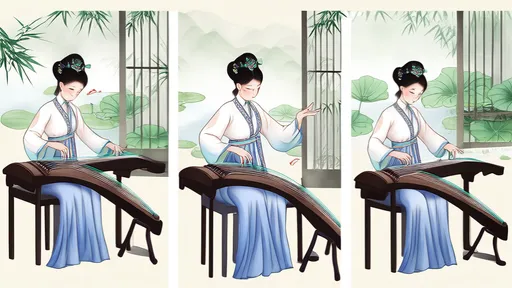
The guzheng, a traditional Chinese zither with over 2,500 years of history, is renowned for its delicate and expressive playing techniques. Among these, the shaking finger technique, stands out as one of the most challenging yet mesmerizing methods to master. This technique produces a continuous, flowing sound reminiscent of a cascading stream, adding depth and emotion to performances. Unlike Western string instruments that often rely on bowing or picking, the guzheng’s yaozhi requires a unique combination of finger agility, wrist flexibility, and precise control over tension.
To begin with, understanding the physical mechanics of yaozhi is crucial. The technique involves rapidly alternating the index finger or thumb over a single string, creating a sustained tremolo effect. The motion originates from the wrist rather than the fingers alone, allowing for a more relaxed and fluid movement. Beginners often make the mistake of tensing up their fingers, which leads to fatigue and uneven sound production. Instead, the wrist should remain loose, acting as a pivot while the fingers maintain a consistent angle against the string. The goal is to achieve a seamless, undulating tone that can be dynamically adjusted to suit the musical context.
Positioning plays a pivotal role in executing yaozhi effectively. The right hand (for right-handed players) should hover slightly above the strings, with the forearm parallel to the guzheng’s surface. The index finger or thumb is then placed at a 45-degree angle to the string, ensuring optimal contact. Unlike other plucking techniques where the finger snaps away from the string, yaozhi requires a gentle but firm "rolling" motion. The fingertip glides across the string in a controlled back-and-forth motion, almost as if coaxing the sound out rather than forcing it. This subtlety is what gives yaozhi its signature ethereal quality.
One of the most common challenges learners face is maintaining an even rhythm and volume. The tendency to speed up or slow down unintentionally can disrupt the musical phrase. To counteract this, many teachers recommend practicing with a metronome at a slow tempo initially, gradually increasing speed as control improves. Another useful exercise is isolating the yaozhi technique on a single string while playing simple melodies, focusing on consistency. Over time, the motion becomes more intuitive, allowing the player to incorporate dynamic shifts—starting softly and swelling into a louder volume, or vice versa—to enhance expressiveness.
The cultural context of yaozhi adds another layer of depth to its mastery. In traditional Chinese music, this technique is often employed to mimic natural sounds, such as wind rustling through bamboo or water flowing over rocks. It’s not merely a technical skill but a means of storytelling. For instance, in the classical piece "High Mountains and Flowing Water" (高山流水), yaozhi is used to evoke the imagery of a bubbling spring, creating a vivid auditory landscape. This connection between technique and imagery is what makes learning yaozhi so rewarding; it’s as much about cultivating sensitivity to the instrument’s voice as it is about physical precision.
Advanced players often experiment with variations of yaozhi to expand their expressive range. For example, combining yaozhi with glissando (sliding between notes) or harmonics can produce hauntingly beautiful effects. Some musicians also modify the angle or pressure of their fingers to alter the timbre, yielding brighter or more muted tones. These innovations highlight the versatility of yaozhi, proving that even a centuries-old technique can adapt to contemporary musical styles without losing its traditional essence.
Ultimately, mastering yaozhi is a journey that demands patience and mindful practice. Unlike flashy techniques that yield immediate gratification, yaozhi reveals its beauty gradually, rewarding those who invest time in refining its nuances. Whether you’re a beginner struggling to maintain a steady rhythm or an advanced player exploring its creative possibilities, the technique invites a deeper connection with the guzheng—one that transcends mere notes and resonates with the soul of Chinese musical tradition.

By /Aug 7, 2025

By /Aug 7, 2025

By /Aug 7, 2025

By /Aug 7, 2025
By /Aug 13, 2025

By /Aug 7, 2025

By /Aug 7, 2025
By /Aug 7, 2025

By /Aug 7, 2025

By /Aug 7, 2025

By /Aug 7, 2025

By /Aug 7, 2025
By /Aug 13, 2025

By /Aug 13, 2025

By /Aug 7, 2025

By /Aug 7, 2025

By /Aug 7, 2025

By /Aug 7, 2025
By /Aug 13, 2025
By /Aug 13, 2025
