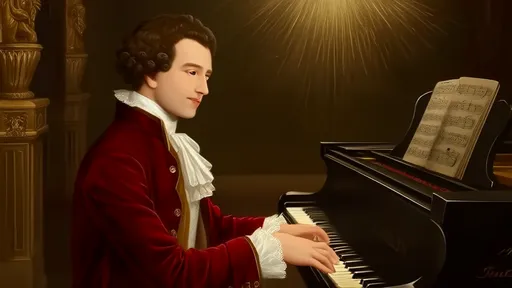
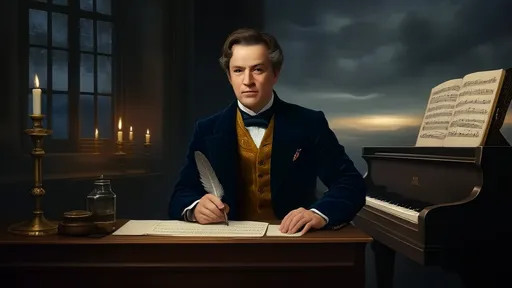
The name Wolfgang Amadeus Mozart conjures images of powdered wigs, harpsichords, and the refined elegance of 18th-century Europe. Yet behind this polished veneer lies one of the most extraordinary musical minds ever to grace our world - a child prodigy who seemed to channel divine inspiration through every composition.
Born in Salzburg in 1756, Mozart displayed preternatural musical abilities almost from infancy. By age three, he was picking out chords on the harpsichord; at four, he could memorize and replay entire musical passages after a single hearing. His father Leopold, himself a respected composer and violinist, recognized his son's gifts early and devoted himself to nurturing this miraculous talent.
The young Mozart's abilities bordered on supernatural. At five, he composed his first minuets - not simple child's scribbles but sophisticated pieces that demonstrated an innate understanding of musical structure. By seven, he was touring European courts, astonishing royalty with his virtuosity on multiple instruments and his ability to improvise complex compositions on demand. Audiences whispered that such talent could only come from divine intervention.
What set Mozart apart wasn't merely technical proficiency but an almost mystical connection to music itself. Contemporary accounts describe how he would compose entire symphonies in his head, then transcribe them without hesitation or revision. His sister Maria Anna recalled finding him as a child, trembling with creative ecstasy after conceiving a particularly beautiful melody, as if receiving visions from some higher realm.
The Salzburg wunderkind's creative output defies human explanation. Before his untimely death at 35, Mozart produced over 600 works including 41 symphonies, 27 piano concertos, and 22 operas - many composed at breakneck speed without sketches or drafts. The manuscript for his overture to "Don Giovanni" famously shows not a single correction, as if the music flowed through him perfectly formed.
Mozart's operas reveal perhaps the deepest evidence of his divine gift. Works like "The Marriage of Figaro" and "The Magic Flute" demonstrate an uncanny understanding of human psychology through music. Characters spring to life through melodies that somehow express their deepest essence - the playful cunning of Figaro, the noble suffering of Pamina, the buffoonery of Papageno. No composer before or since has matched this ability to translate soul into sound.
Even Mozart's compositional process seemed miraculous to observers. Unlike contemporaries who labored over their scores, Mozart worked with joyful ease, often composing while playing billiards or carrying on conversations. The music appeared fully formed in his mind, requiring only the mechanical act of notation. "The music is not in the notes," he once said, "but in the silence between."
His sacred works particularly suggest celestial inspiration. The unfinished "Requiem" - composed as he lay dying - contains passages of such sublime beauty that many believe Mozart was quite literally writing his own passage to the afterlife. The "Ave Verum Corpus," a brief Eucharistic hymn, condenses profound spiritual expression into just 46 bars of music that still moves listeners to tears centuries later.
Mozart's relationship with the divine wasn't without its paradoxes. The man who composed some of Christianity's most transcendent sacred music also delighted in vulgar humor and lived much of his life in financial disarray. This juxtaposition makes his achievements all the more remarkable - the divine melodies emerged not from some ascetic saint but from a flesh-and-blood man who enjoyed wine, women, and off-color jokes.
The physical artifacts of Mozart's genius continue to astonish. Examining his manuscripts today, one finds almost no corrections or revisions - the notes spill across the page with confident precision, as if he were merely taking dictation from some heavenly source. Musicologists still marvel at works like the "Jupiter" Symphony's finale, where five distinct melodic themes interweave in perfect counterpoint - a feat of musical architecture that would challenge most composers even with modern tools and time.
Perhaps most telling are the accounts from fellow musicians. When the legendary Joseph Haydn first heard Mozart's music, he told Leopold Mozart, "Before God and as an honest man, I tell you that your son is the greatest composer known to me either in person or by name." High praise indeed from the father of the symphony himself.
Mozart's influence transcends classical music. His melodic gift shaped everything from Beethoven's piano concertos to Broadway show tunes. The clean elegance of his phrasing informs jazz improvisation; the emotional directness of his arias resonates in pop music. Even people who've never set foot in a concert hall can hum tunes from "Eine Kleine Nachtmusik" or "The Magic Flute."
Modern science has tried to explain Mozart's genius through everything from perfect pitch to synesthesia. Some researchers suggest his childhood exposure to diverse musical styles created unique neural pathways. Others point to his ability to retain and process complex auditory information. Yet all such explanations feel inadequate when confronted with the sheer otherworldly beauty of works like the Clarinet Concerto or the "Dissonance" Quartet.
In the end, perhaps we must accept that some gifts defy rational explanation. Like a lightning rod for divine creativity, Mozart channeled musical perfection that still elevates the human spirit centuries later. As his contemporary the poet Franz Grillparzer wrote at Mozart's graveside: "A god has spoken here - now he has returned to his heavenly home." The music remains as proof of that celestial visitation - notes on a page that still carry the kiss of the divine.
Two hundred and sixty-eight years after his birth, Mozart's music continues to perform its greatest miracle - bridging the gap between earthly and divine, between human limitation and artistic perfection. In concert halls worldwide, when those crystalline melodies rise, listeners of all backgrounds experience the same awed silence that once fell over European courts when the child prodigy performed. That hush contains the unspoken recognition: we are in the presence of something beyond mortal creation.
The legend endures because the music demands it. Every perfectly balanced phrase, every heart-stopping modulation, every effortless fusion of complexity and clarity whispers the same truth: here walks - if only for a moment - the divine in human form. Wolfgang Amadeus Mozart remains, as ever, God's musical shorthand for perfection.
By /Aug 7, 2025
By /Aug 7, 2025

By /Aug 7, 2025
By /Aug 7, 2025
By /Aug 13, 2025

By /Aug 7, 2025

By /Aug 7, 2025

By /Aug 7, 2025
By /Aug 7, 2025
By /Aug 7, 2025
By /Aug 7, 2025
By /Aug 7, 2025

By /Aug 13, 2025

By /Aug 13, 2025
By /Aug 7, 2025

By /Aug 7, 2025

By /Aug 7, 2025

By /Aug 7, 2025

By /Aug 13, 2025
By /Aug 13, 2025
